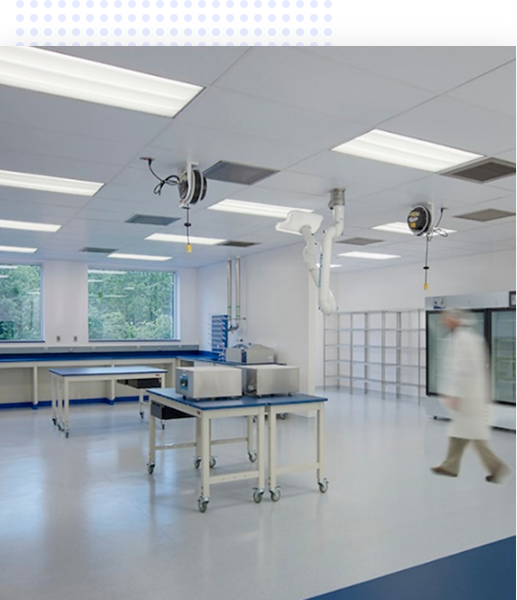
Controlled Environments for Cleanrooms
For more than ten years, the Q2ESB team has been designing, building, and qualifying controlled environments for industrial companies and healthcare facilities in Tunisia and France. From pharmaceutical laboratories to operating rooms in private clinics, as well as cosmetic and agri-food production units, every project we undertake is based on the same principle: a poorly designed cleanroom will always cost more than one that is properly designed from the outset.
With offices in Tunis and Paris, we continuously monitor regulatory developments on both sides of the Mediterranean, enabling us to respond quickly across all our projects.
Tailor-Made Cleanroom Design and Construction
Designing and building a cleanroom is not simply a matter of choosing smooth materials and HEPA filters. It is a systems engineering exercise in which every decision—the differential pressure between two rooms, the location of a duct, or the opening direction of an airlock door—has a direct impact on the final ISO classification and on the facility's ability to maintain that classification over time.
Our approach begins with a systematic risk analysis, conducted with the future operator before a single drawing is produced, and continuously updated through to commissioning. This step, often overlooked by general contractors, is non-negotiable for us: it is the only way to develop URS (User Requirement Specifications) that are genuinely tailored to your process rather than copied from a previous project.
View Our ReferencesWhat We Master
After years of working on pharmaceutical, healthcare, and industrial projects, certain issues consistently arise when the design has not been carried out with sufficient rigor:
- Air treatment with multi-stage filtration and continuous airflow monitoring
- Monitoring of airborne particles, temperature, and humidity
- Management of pressure cascades and recovery time to the required cleanliness class
- Selection of materials and surface treatments suitable for each sector
- Definition of cleaning processes, entry/exit protocols, and maintenance plans
We have encountered these situations on facilities where we were called in to conduct audits or corrective work. They have taught us that the quality of a cleanroom is largely determined before the first drill is used.
As with most controlled environments, cleanroom design begins with a highly detailed risk analysis, carried out with the future operator from the very beginning of the project and continuously updated through to commissioning.
Our in-depth knowledge of regulations, filtration stages, and URS enables us to control:
- The spread of microbiological contamination
- Pressure cascades
- Temperature
- Humidity
- Particle distribution within cleanrooms
- Recovery time to the required cleanliness class
Our Project Charter
Over the course of our projects, we have formalized four commitments that consistently guide our technical decisions:
Safety and Integrity
Every material is selected to ensure perfect airtightness and resistance to the decontamination agents used in your industry.
Ergonomics and Workflow
A controlled environment must be practical for everyday use. We design circulation areas, airlocks, and workstations so that your operators can follow procedures without them becoming a constraint.
Durability and Reliability
We select industrial-grade components designed to withstand intensive decontamination cycles over time. An installation that ages poorly is an installation that may drift from its required classification.
Compliance and Qualification
We design every installation to be compliant from the initial qualification. This is not one objective among many; it is the success criterion for every project.
Our Areas of Expertise
As a cleanroom engineering company, we operate across a wide range of controlled environments:
Pharmaceutical Industry
GMP compliance, ISO 7 and ISO 8 classifications, and controlled-atmosphere areas for sterile production.
Medical Devices
ISO 13485 framework, MDR requirements, and enhanced traceability of materials and equipment.
Microelectronics
ISO 5 and ISO 6 environments, with control of submicron particles and vibrations.
Food Industry
HACCP clean zones, ISO 22000, and food-grade compatibility of all materials in indirect contact with products.
Healthcare Facilities
Operating rooms and sterile care units in accordance with the NF S 90-351 standard, taking into account the specific architectural and logistical constraints of operational healthcare environments.
Why Choose Q2ESB for Your Cleanroom Design and Construction?
At Q2ESB, cleanroom design and construction are based on extensive technical expertise and in-depth knowledge of regulatory requirements. We systematically incorporate the requirements of ISO 14644 for the classification of controlled environments, as well as the specific requirements of NF S 90-351 for healthcare environments. This approach ensures facilities that not only comply with the highest standards but are also optimized for the performance and operational safety of your critical activities. We ensure that every technical detail contributes to the integrity of your controlled environment.
Every project is unique, and this is the foundation of our approach. We adapt our solutions to the specific requirements of various sectors, including the pharmaceutical industry, microelectronics, and biotechnology. Our project management process is structured to ensure precise coordination, from initial engineering through to the final qualification of the facilities. This methodical approach enables us to control schedules and costs while ensuring execution in compliance with the most stringent requirements—essential for environments where precision is paramount.
Ready to Launch Your Project?
Are you planning to build or renovate a cleanroom, or are you looking to qualify an existing facility? Our experts support you from the earliest stages. Let’s meet to assess your requirements and define together the validation strategy best suited to your operations.
FAQ: Questions About Controlled Environments
What is the difference between a cleanroom and a controlled environment?
A controlled environment is a general term referring to any space where one or more environmental parameters (temperature, humidity, pressure, biocontamination) are continuously monitored and controlled. A cleanroom is a specific type of controlled environment defined by ISO 14644-1, where the concentration of airborne particles is strictly limited, classified, and controlled. All cleanrooms are controlled environments, but not all controlled environments are necessarily cleanrooms.
How is the ISO cleanliness class of a cleanroom determined?
Classification is carried out in accordance with the international ISO 14644-1 standard, which ranges from ISO 1 (the cleanest) to ISO 9. It is determined by calculating the maximum particle concentration per cubic meter of air for specified particle sizes (ranging from 0.1 µm to 5 µm). Physical measurements are performed using an optical particle counter at various strategically selected sampling points and under specific facility conditions: after construction, at rest, or during operation.
What are the main parameters to control in a controlled-atmosphere area (CAA)?
Beyond particle counting, controlling a CAA relies on regulating four critical parameters:
- Air change rate: Ensures the rapid dilution and removal of contaminants.
- Differential pressure: A pressure cascade (generally 10 to 15 Pascals between each zone) prevents unfiltered air from adjacent areas from entering cleaner spaces.
- Temperature and humidity: Stabilized to ensure operator comfort (limiting perspiration), proper operation of precision equipment, and product stability.
- Airflow pattern: Unidirectional airflow (laminar flow) for highly critical areas or non-unidirectional (turbulent) airflow for standard classifications.
What is the difference between HEPA and ULPA filtration?
The difference lies in the retention efficiency of these high-efficiency filters. HEPA (High Efficiency Particulate Air) filters, commonly used in industrial and healthcare cleanrooms (H13 and H14 classes), remove at least 99.95% or 99.995% of 0.3 µm particles. ULPA (Ultra Low Penetration Air) filters, ranging from U15 to U17 classes, provide higher efficiency, reaching up to 99.999995% for the most penetrating particles (0.12 µm), and are primarily used in advanced industries such as microelectronics and nanotechnology.
What is NF ISO 17141 and how does it differ from ISO 14644?
While the ISO 14644 series focuses exclusively on inert particulate contamination (dust and fibers), NF ISO 17141 specifically addresses the control of biocontamination. It defines requirements for assessing and controlling viable contaminants (bacteria, fungi, and spores) in controlled environments. It therefore primarily applies to sectors where biological risks are critical, such as the pharmaceutical industry, medical devices, and healthcare facilities.