
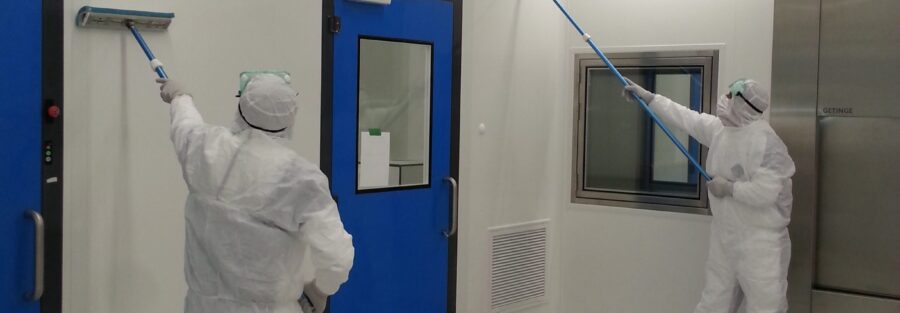
After an interruption in pharmaceutical industry activities, many facilities exposed to microbiological risks will need to undergo a new cleanroom clearance process. When and how should a cleanroom clearance process be implemented?
In the current context of the COVID-19 pandemic, vigilance is essential to ensure a safe resumption of activities. Indeed, following a prolonged shutdown in a controlled environment such as a cleanroom, certain cleaning procedures are recommended. Cleanroom clearance is the standard operation for eliminating contamination risks and ensuring optimal safety. When and how should automatic Airborne Surface Disinfection (ASD) be implemented as part of a cleanroom clearance process, and what are its advantages and regulatory requirements in light of the new European directives?
Cleanroom clearance is a set of manual and automatic cleaning and disinfection procedures designed to restore an area to compliance before qualification. It should not be confused with grey room clearance (which precedes cleanroom clearance), which generally focuses on the primary cleaning operations required to ensure effective final clearance.
Following a planned or unplanned shutdown resulting from non-conformities identified through particulate and/or microbiological sampling, the cleanroom clearance process defines all the protocols and steps to be followed in order to successfully complete the qualification process for the target area and resume activities. Cleanroom clearance is an essential step before any restart of operations following a period of shutdown.
The cleaning and disinfection stages should be clearly separated during a cleanroom clearance process. Cleaning must always precede disinfection. Cleaning is a manual process covered by a precise protocol detailing all cleaning steps (products used, sequence, cleaning technique, and validation of the cleaning process). Disinfection is the stage following manual cleaning and represents the final step of the cleanroom clearance process before qualification. It must therefore be carried out carefully and requires complete validation. Disinfection can be performed manually and/or automatically using Airborne Surface Disinfection systems.
Airborne Surface Disinfection (ASD) is an automatic process carried out in the absence of personnel, or a manual process using directed spraying. It is a validated and measured procedure designed to achieve homogeneous disinfection of all surfaces within the target area.
Automatic ASD, when performed, represents the final stage of the cleanroom clearance process before qualification for the resumption of activities. It ensures that all surfaces, including surfaces that are not accessible during manual cleaning and disinfection, are properly disinfected, with a precise and validated measurement of the level of disinfection achieved. Validation of the automatic ASD process provides assurance that the treated areas can return to a qualified state.
Automatic ASD consists of dispersing a biocidal product within a defined volume, allowing homogeneous disinfection of all exposed surfaces. Several automatic ASD technologies are available, providing different levels of disinfection depending on environmental conditions and the volumes to be treated. Automatic ASD systems are subject to European standards (BPR — **EN 17272**, replacing **NF T72-281**).